
Cindy’s Story
Re-activating a Whirlwind: Renaissance Woman’s Return to Chaotic Life
Cindy Way Caple gets bored easily. She needs to feel challenged. Constantly.
By day, the Northern Virginia resident works as a talent development executive for the federal government.
By nights and weekends, Cindy is a 51-year-old renaissance woman. She is a competitive-rowing, opera-singing, triathlon-running, Highland Games-participating whirlwind who once was a youth karate champion.
“My mission – my purpose – is to learn and do cool things,” she said.
In January, six months into a year-long course to receive her artistic certification in blacksmithing – yes, blacksmithing, the process of heating and hammering metal into desired shapes and designs – she made a crucial mistake.
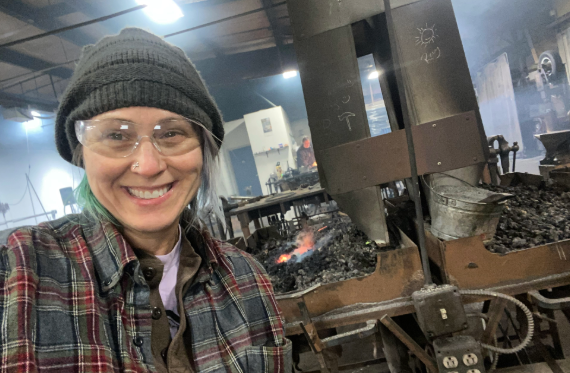
Using an industrial power hammer, she attempted to bend a one-inch square of metal that was no longer hot enough to contort. The metal didn’t absorb the collision’s force, and the pressure had to escape somewhere.
It chose Cindy’s right arm, causing a shockwave of energy so potent it tore tendons almost completely off the bone.
The pain was intense. The reality, worse.
She couldn’t lift her arm. The whirlwind had lost all air.
Needing a second chance at physical therapy
The pain initially didn’t stop Cindy. She kept bending and shaping metal that day and the following one. She had a project to complete.
“The next day in class, I literally couldn’t pick up the hammer,” she said. “Trying to work left-handed was super fun, but I got through it.”
Once the project was done, she rested for a few days. Iced her elbow. Elevated it. Took it easy.
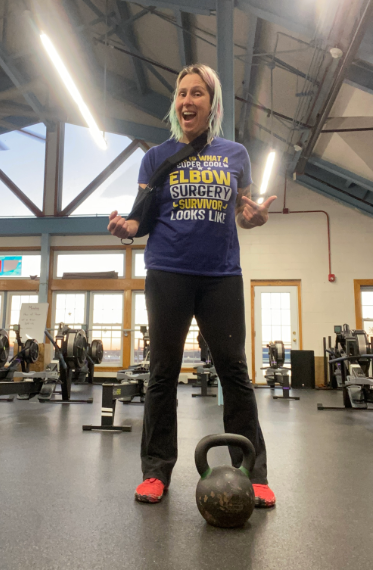
Rowing season was looming, though. So, she returned to the gym to powerlift once her elbow felt better. Her second mistake. This time, the pain was unbearable.
“I knew something was really wrong.” she said. “That is when I realized I had definitely done some damage.”
Tests showed her extensor tendons, which allow for the straightening or extending of the fingers, wrists and forearms, were “hanging on by a thread.”
She had elbow surgery in early March. In April, she went to an outpatient physical therapy center. Immediately, she hated the experience. It was an impersonal assembly line of aching bodies.
The clinician didn’t listen to her patient’s concerns. She started Cindy too quickly on an arm bike. Had her lifting weights that were too heavy for her stage of recovery. Told her the piercing sensation in her arm was normal.
After a second session, and more agony, Cindy stopped treatment. It was too much. After more weeks of continued discomfort, she looked for another company and center. She found Select Physical Therapy’s Alexandria - Mount Vernon center and Physical Therapist Mitsu Vaidya.
“Mitsu was very warm and welcoming. She sat me down and asked about my pain, and I was like, ‘Everything hurts. My soul hurts. I can’t do anything,’” Cindy said. “She’s like, ‘It’s going to be fine.’ And she helped me through this entire process.”
A poker face and helping hand
Mitsu became a certified and practicing physical therapist in India in 2006. After she and her husband moved to the United States, she completed her U.S. certification in 2020. She joined Select Physical Therapy in 2021 and is now a center manager.
Since entering the profession two decades ago, Mitsu has formulated her pain relief philosophy: Physical therapists minimize pain; they don’t cause it.
Given that, Mitsu and Cindy were a perfect match. Cindy would work as hard as Mitsu directed; she just didn’t want to be pushed into further anguish. Mitsu wouldn’t allow that to happen.
“Soreness is fine. But pain, we do not do that. We went through it slowly, gently. I came up with a program for her, to progress her,” Mitsu said. “I am like, ‘This is what we have to offer. Try and do it. If you like it, we’ll continue. Otherwise, if you are in pain, we do not .’”
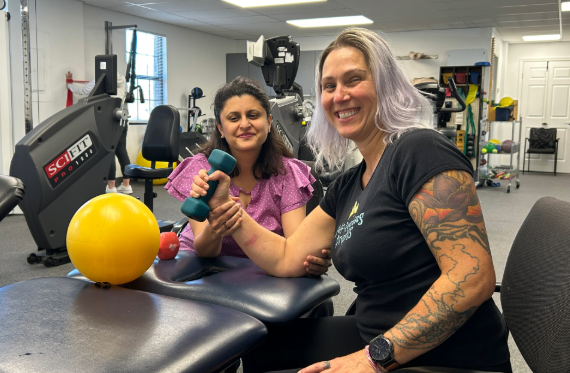
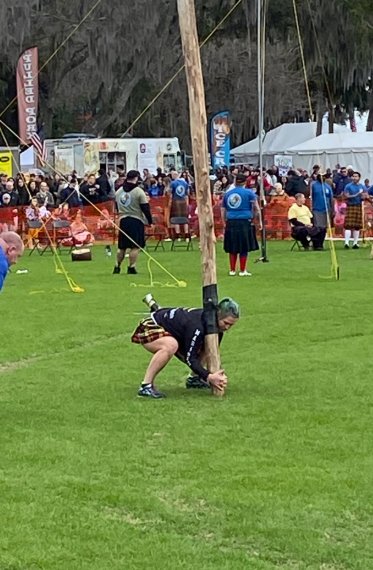
Mitsu’s one-on-one, physical therapy program started with stretches, light exercises and lifting weights of only a few pounds. It was somewhat embarrassing for Cindy, who as a Highland Games competitor is accustomed to grabbing and tossing kettlebells and cabers, a tapered log that resembles a sawed-off telephone pole. Lifting a two-pound barbell was not the same.
Still, Cindy bought-in fully to Mitsu’s plan, trusting her physical therapist’s experience, calm demeanor and, well, her poker face.
When Cindy explained her goals and what activities she wanted to continue, such as racing a rowboat, carrying a caber and hammering searing metal, Mitsu listened, showing no emotion or concern.
“The first reaction was, ‘Uh huh,’” Mitsu said. “I’ve never worked with such an active patient. But we are used to listening to other activities. Hers are astonishing in my head, but our job is face-presentation. We have to be that neutral person, listening and taking it in. And then say, ‘This is what we have in plan for you.’”
Rowing, singing, throwing and more
Active is one way to describe Cindy’s life. Extraordinary is another.
Her father worked for Exxon, so her family moved around the world. She lived for a spell in Saudi Arabia, went to boarding school in Massachusetts.
She enlisted in the U.S. Navy and worked as a “cryptologic technician maintenance,” building computer networks and systems. While in the Navy, she was involved in equestrian competitions.
Theater – she performed in plays and sang opera – and karate were her jams for a while. She competed in multiple Junior Olympics, once winning her age group in kata (karate forms).
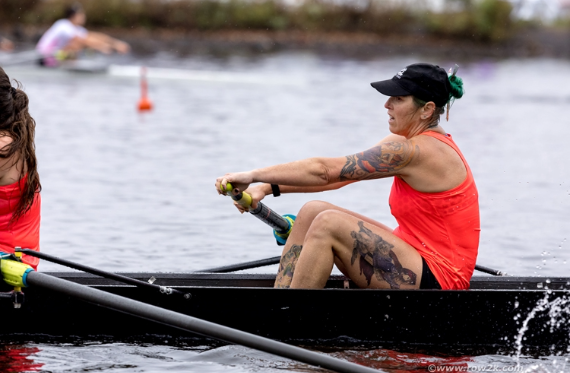
She rowed while at boarding school and then gave up the sport for roughly two decades before falling in love with it again. In 2016, Cindy and her husband, James, attempted to row the North Atlantic Ocean but were defeated by a hurricane. In another bold adventure, the couple navigated 120 miles on the Potomac River in a wooden rowboat built by James, a software engineer.
It was her bagpipe-playing husband who introduced Cindy to the Highland Games, a celebration of Scottish and Celtic culture, music, dance and sport, including field events featuring massive humans lifting and throwing odd objects as far as possible.
Despite being 5-foot-4 – she calls herself “a hobbit” compared to other competitors – Cindy thought it looked fun and, like blacksmithing, it wasn’t something many women did. So, she gave it a shot.
Cindy trained with an online coach and made her Highland Games debut at a regional event. She surprisingly held her own and was hooked. Since, she has crafted her own pitchfork and uses it in competitions to toss burlap bags of straw (sheaths) over goalposts.
“I’m a terrible thrower, but my fork is really pretty,” Cindy joked.
She normally competes in three Highland Games per year but couldn’t in 2025. She also shelved rowing and suspended her blacksmithing course halfway through the required year.
“It was excruciating for me, because I am used to doing all these things and then I had to sit still,” she said. “And that was just terrible .”
Never a pain as a patient
Building a physical rehabilitation plan for a patient who works at a desk, operates power tools and tosses logs for fun is not a chapter in the physical therapy casebook.
There is protocol for extensor-tendon rehabilitation, however, so Mitsu started there.
“As soon as the patient tells me, ‘This is what I want,’ I go to the muscles. My brain works in that direction,” Mitsu said. “In her case, it was the elbow, but it’s the muscle and joint function, and how is that related? That’s how we came up with the program.”
Mitsu’s plan included a combination of honing fine- and gross-motor skills: Using a keyboard in a way to minimize pain; holding a hammer differently; lifting weights straight-armed to replicate the motion of throwing kettlebells.
As she progressed, Cindy pushed too hard. She wasn’t supposed to begin rowing again until July. She tried in May. Another mistake. She returned to physical therapy hurting.
“I went to Mitsu and said, ‘My arm is sore. I’m dumb. I’m rowing again,’” Cindy said. “And she just shook her head at me and rolled with it. She is a very patient woman, and she helped me navigate that, me being stupid and getting back into things early.”
Mitsu spins it another way. Cindy is passionate and eager to return to what she loves. She is driven. Those patients, Mitsu said, are a therapist’s dream, even if Cindy characterizes herself as “a pain in the butt."
“Not at all. My patients are never a pain to me,” Mitsu said. “If that would have been the case, I wouldn’t be in this profession.”
Finding her second whirlwind
Cindy is returning to her frenetic life, little by little.
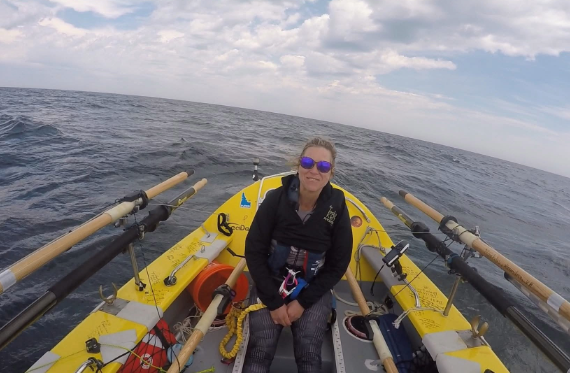
She competed in the masters division of the rowing national championships in July. This February, she’ll restart her blacksmithing course from where she left off after her mishap. She expects to earn her certification by August.
She hopes to enter a Highland Games competition in January, though there is work to do to get there. She can complete only two pushups and one pullup right now.
Months ago, however, when she first entered Select Physical Therapy and met Mitsu, Cindy couldn’t raise her right arm.
“I was a hot mess when I came in, and now, I’m a functioning human being again,” Cindy said. “It’s all thanks to Mitsu.”
Cindy wants everything to move faster, of course. She thrives on her world spinning non-stop.
But she’s listening to Mitsu. Mitsu is listening to her. And the wind is beginning to whirl again.