
Tracie's Story
Soaring again: Age, disabling disease, ‘gnarly’ fall can’t ground wheelchair skateboarder
Tracie Garacochea wanted one more drop.
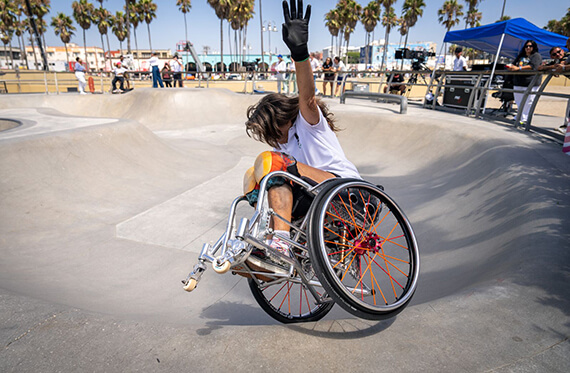
It was her final run during an annual skateboarding fundraiser on Mother’s Day in Laguna Niguel, California, and she yearned for another plunge into the skating bowl. Routine, nothing crazy.
She hadn’t been feeling well after stopping a medication a few days earlier and, in retrospect, figures she should have called it a day.
Instead, Tracie parked at the bowl’s crest, leaned forward to descend like she’s done a thousand times before, and somehow lost control, immediately falling and face-planting onto the concrete.
Blood gushed from her forehead, nose, below her left eye. On all fours, she realized she couldn’t push off with her left arm.
Stunned silence blanketed the charity event.
Seemingly, everyone at every skatepark in Southern California knows Tracie, the sport’s unofficial, one-woman welcoming committee. She’s a helmet-and pads-wearing unicorn.
Tracie is 65 – decades older than typical skateboarders.
She has multiple sclerosis, a nervous system disease that hampers her balance and walking.
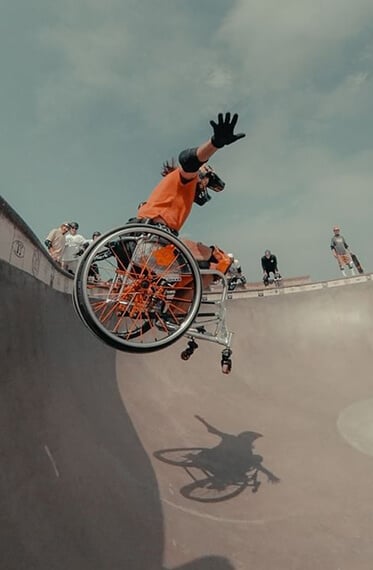
Her “skateboard” is a specially designed wheelchair that allows her to do spins and tricks.
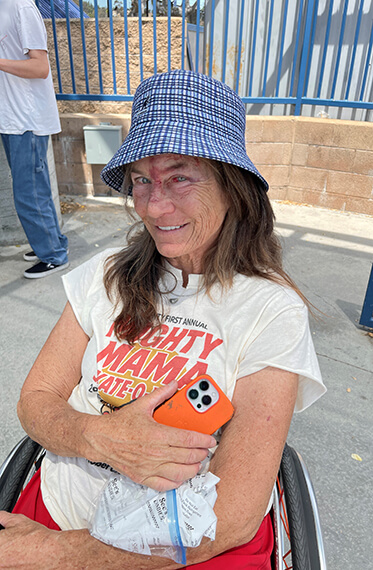
It’s a wheelchair she crashed in a very public way. The accident eventually sent her to the emergency room and for several months of treatment at Select Physical Therapy’s Santa Monica center.
In that moment, however, Tracie brushed the blood and pain aside, smiled and crooned: “I took a little tumble.”
The tumble’s ‘gnarly’ reality
Minutes after Tracie’s crash, Julie Daniels arrived at the “Mighty Mama Skate-O-Rama” fundraiser for victims of domestic abuse and trafficking.
The two women first met eight years ago at the same event. Julie, now 60, had joined a moms’ skateboarding group and was nervous about participating in a large event with younger, more accomplished strangers.
One of the first people to greet her was this older woman in a faerie outfit sitting in a wheelchair covered in butterfly pictures. Talk about taking the edge off.
“She was so nice. She already seemed to know everybody, and she was very welcoming,” Julie said about Tracie. “It’s a real gift she has.”
They quickly bonded, and Tracie soon became an inspiration for Julie – well, mostly.
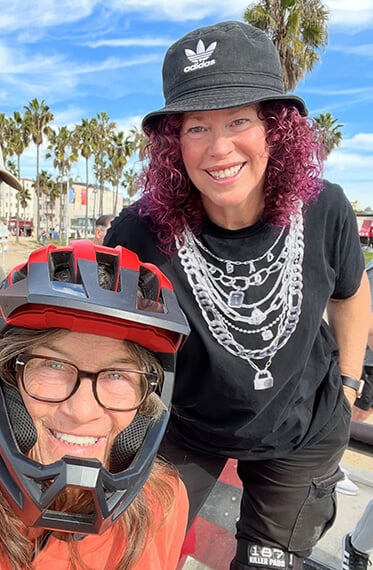
“I’d say I’m part inspired, and part freaked out by her,” Julie said, “Because sometimes she takes risks that make my stomach drop. But she has always been OK.”
Tracie told everyone she was OK after the Mother’s Day crash. She didn’t enter the bowl again, but didn’t leave the park, either, choosing to hang out for a few more hours. She downplayed the pain and made her 90-minute drive home by herself.
“Her face was the main attraction because it had bleeding around her nose,” Julie said. “It was gnarly, honestly. But she was laughing and making everybody feel comfortable and encouraging everybody to go skate like usual.”
Later that night, Julie texted to see how her friend was doing.
Tracie answered from the emergency room; she had a broken left elbow, a broken left wrist and a separated left shoulder.
Not a banner day
Tracie has spent much of her adult life dealing with physicians. At 18, she experienced vertigo symptoms and underwent testing via the first MRI machine in Santa Monica. Not surprisingly given the newness of the technology, the test revealed nothing.
Doctors ruled out a brain tumor and multiple sclerosis. They surmised she had a repetitive inner-ear infection and couldn’t do much about it. So, Tracie continued with her active life as a track athlete and “a gymnast who had horrible balance.”
Her discomfort continued for years. In her 40s, she finally received the multiple sclerosis diagnosis.
“Honestly, I wasn’t surprised,” she said. “It wasn’t a banner day.”
It wasn’t a white flag day, either.
Multiple sclerosis has altered how she does things; it hasn’t stopped her from doing them.
Tracie, who worked in the food industry for years, eventually followed her childhood dream and became a stone sculptor. Due to her physical limitations, she no longer grasps chisels and files effectively, so she’s switched to photography, creating collages or transferring photo images and painting their backgrounds to produce new art.
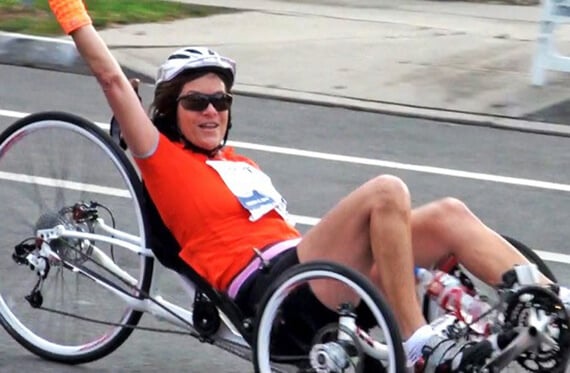
She once loved running, primarily barefoot on the beach, but when that became too difficult, Tracie took up adaptive cycling and has completed more than a dozen Los Angeles marathons with a recumbent trike or wheelchair.
A passionate gardener, Tracie often shows up to events – including physical therapy – with freshly cut flowers in hand.
Skateboarding, though, may be her primary love.
While volunteering 10 years ago with children who were learning adaptive cycling, she was invited to accompany them to a skatepark. At the time, Tracie exclusively used a cane and didn’t want to be wheelchair-bound. She wasn’t mentally ready for that decision.
That day at the skatepark, a woman asked Tracie if she wanted to give her wheelchair a spin on a winding track. She did. And was hooked. Several months later, she had her own customized chair.
Now, she’s a wheelchair motocross professional, winning various tournaments; she placed second in the 2021 women’s adaptive street finals at the prestigious Dew Tour Skateboard Competition in Iowa. She had the highest finish of anyone in a wheelchair.
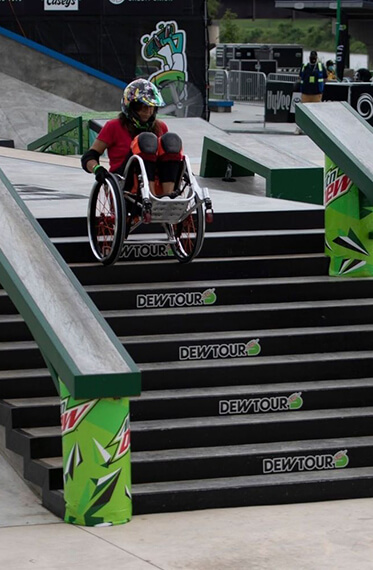
She received a bit of media attention for that accomplishment, something that still makes her chuckle. Her big interview was a video spotlight with a local AARP chapter. Well, she jokes, she didn’t join the sport seeking media glory.
“It’s the air rushing past your head. It’s the capability of learning something new. It’s going higher. It’s surprising people,” she said of why she skateboards. “It’s something I can do and I’m good at it. I may be old, but I’m good at it.”
Challenging physical therapy
Tracie isn’t shy about discussing her age or physical challenges.
She lives a full life. She’s been married 33 years to her husband Jay – they met through golfing; he doesn’t skateboard and doesn’t come to her competitions because he “gets scared watching.” She has tons of friends, two stepchildren and two spoiled greyhounds.
“A lot of people will look at me and see either the wheelchair or they’ll look at my age and will treat me like somebody who sits around and knits all day,” she said. “Doctors will do the same thing. People look at you and will treat you by how you look.”
That’s what she feared would happen after her crash. A lot of tiptoeing around the senior citizen instead of providing intense rehabilitation to the athlete. At Select Physical Therapy, her perspective changed.
“I felt I was listened to at physical therapy. I didn’t want to be treated like a grandma,” she said. “I wanted to be back in athletic shape, and that’s what I got.”
When she arrived for therapy, her left side was weak and had little range of motion, making it difficult to carry items, navigate her wheelchair and get in and out of a car. Improving those were practical goals. She also had an impractical one: Be back at the skatepark in two months.
Tracie pursued her recovery with passion and purpose, performing progressive strengthening and stretching exercises and receiving manual therapy to loosen previous scar tissue twice a week. She challenged her therapists to challenge her. They did.
“On the two-month anniversary, I went to the skatepark, and I did the trick that I broke on. Because I needed to know I could, and I also needed to know what I still needed to work on,” Tracie said. “Honestly, I now feel like I am coming back even stronger.”
Helping others fly
A lot of what drives Tracie is internal. Competitive fire. Attaining the unattainable.
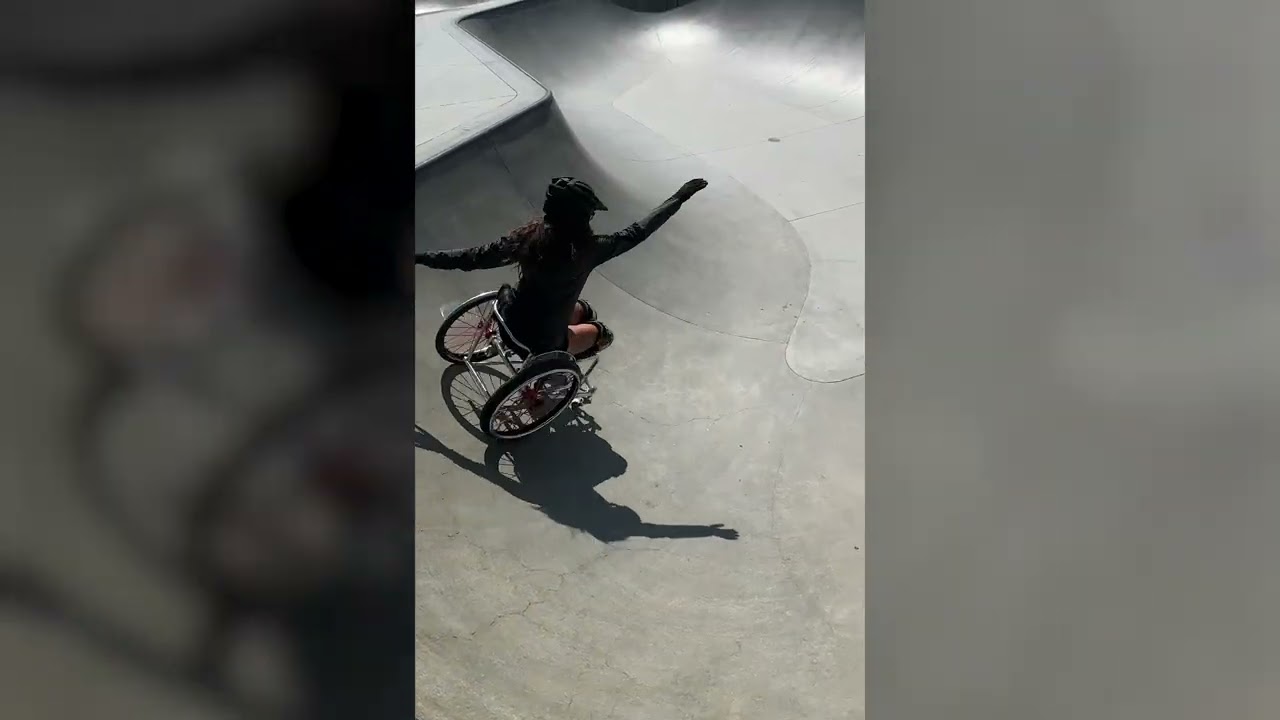
Play the accessible version of the “Wheelchair skateboarder's first ride since injury” video
There is something else, too. Using her platform to help others like her fly.
She can afford an expensive, lightweight wheelchair with shock absorbers, carbon-fiber wheels and easily grippable rims. She’s become friends with the builders and has learned how to replace parts if something comes loose. She has advantages many in wheelchairs don’t have.
Most insurance companies won’t pay for the specialized equipment, meaning those with mobility issues often don’t get the opportunity to try wheelchair motorcross, which hampers the sport’s ability to grow. It’s not part of the paralympic games and may never be.
That saddens Tracie. She knows how empowering pushing a wheelchair around a concrete bowl and soaring into the air can be.
She wants it to be a familiar sight at skateparks, not a rarity. She wants insurance companies to understand the therapeutic nature of the sport. She wants corporate sponsors to help kids pay for the chairs and open their opportunities.
“What I really want is for people to know that people who are disabled, especially the kids, they need better chairs, they need more exposure, they need to see themselves out there,” she said. “When people see me and I’m doing silly stuff, they’re like, ‘Oh my gosh.’ But for me, it’s not ‘Oh my gosh.’”
‘Incredible resilience and spirit’
Minutes after the Mother’s Day crash, Jess Robledo, programs director for Exposure Skate, a non-profit organization that empowers women, girls and non-binary individuals to skateboard, stopped by to check on Tracie.
Hearing upbeat chatter, Jess did what came naturally.
She kissed her friend on the side of the head while someone snapped a photo.
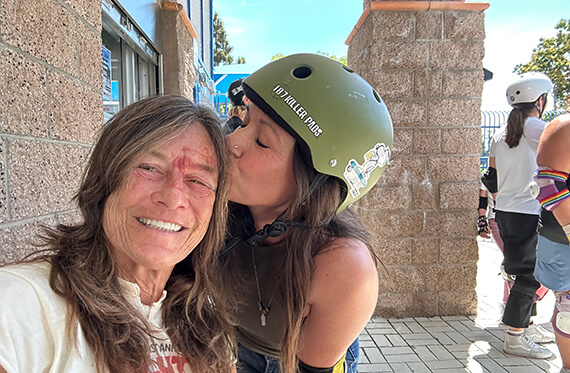
“Once I knew she was OK, the only right thing to do was embrace her with the same love and admiration she always gives to others,” Jess said. “An acknowledgment of her incredible resilience and the spirit she brings to our community.”
Tracie is smiling widely, her face streaked with fresh bruises.
Jess’ eyes are closed, her skate helmet on.
The sense of concern, of relief, is palpable.